
LASIK eligibility is decided by a combination of factors: adequate corneal thickness, a regular and stable corneal shape on topography/tomography, a stable prescription, healthy tear film, good general eye health, appropriate age and lifestyle — assessed together by your surgeon. Eye power alone never decides eligibility.
The eligibility framework
\nThink of eligibility as a checklist where every item must pass — one abnormal finding can change the recommendation from LASIK to PRK, ICL or no surgery at all.
\nFactor by factor
\n1. Eye power (refractive error)
\nLASIK corrects a defined range of myopia, hyperopia and astigmatism. Very high powers may be better served by ICL, and powers near the limit require especially careful thickness calculations.
\n2. Corneal thickness (pachymetry)
\nLaser reshaping removes tissue. Enough must remain afterwards to keep the cornea biomechanically stable for life. Thin corneas may be directed toward surface laser (PRK) or ICL instead.
\n3. Corneal shape (topography & tomography)
\nMaps must show a regular, symmetric pattern with no sign of early keratoconus or other ectatic change — including on the back corneal surface, which only tomography assesses. An abnormal map is the single most important reason LASIK is declined. What topography shows.
\n4. Prescription stability
\nYour power should have been stable for about a year or more. A changing prescription — especially in younger patients — may signal progressing myopia or early keratoconus; operating on a changing eye gives unstable results.
\n5. Dry eye and the ocular surface
\nDry eye is assessed and treated before surgery: it distorts measurements and is temporarily worsened by LASIK. Significant uncontrolled dry eye can shift the recommendation. About dry eye.
\n6. Pupil assessment and night vision
\nLarger pupils in dim light can be more prone to night-time glare and halos after laser correction; this is measured and factored into planning and counselling.
\n7. Retinal and general eye health
\nA dilated retinal examination is performed where indicated — particularly in higher myopia, which carries its own retinal risks that LASIK neither causes nor cures. Cataract, glaucoma or corneal disease change the plan.
\n8. Age, lifestyle and expectations
\nGenerally 18+ with realistic expectations. Contact-sport athletes and some occupations may favour flap-free PRK. Understanding that reading glasses come with age (presbyopia) is part of honest consent.
\n9. Medical history and pregnancy
\nCertain autoimmune diseases, uncontrolled diabetes, keloid tendency and some medications affect healing. Laser vision correction is generally postponed during pregnancy and breastfeeding because hormonal change can shift refraction.
\nSelf-check: should you book a refractive evaluation?
\n\nWhat happens at the evaluation
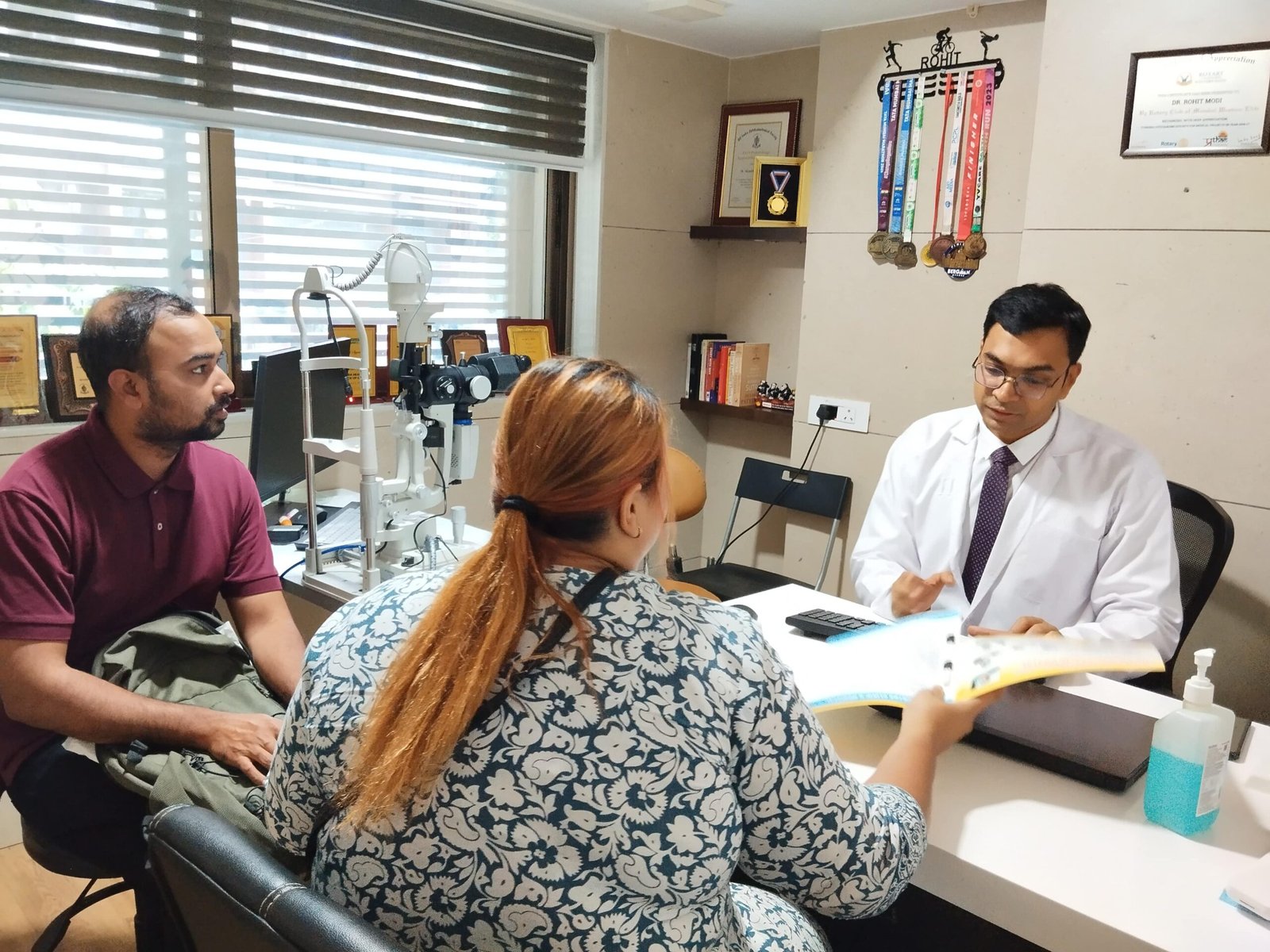
\nRefraction, pachymetry, topography, tomography, tear-film assessment, pupil measurement and a full eye examination, followed by a one-to-one discussion of your data and the options it supports. Details of each test · Book an evaluation.
Information on this page is for general education and does not replace an examination, diagnosis or personalised medical advice from a qualified eye-care professional.
FAQs: LASIK Eligibility: What Actually Decides If You Can Have LASIK
It depends on how much tissue must be removed for your power and how much would remain. Below safe limits, LASIK is declined and alternatives such as PRK or ICL are discussed.
No. Online quizzes (including ours) can only suggest whether an evaluation is worthwhile. Eligibility requires corneal imaging and examination.
Related treatments & topics
Corneal Topography: What the Map Shows & Why It Matters
Corneal topography is a painless imaging test that maps the curvature of the cornea's front surface, displayed as a colour map. It…
Learn moreLASIK Specialist in Mumbai
LASIK is a laser procedure that reshapes the cornea to correct myopia, hyperopia and astigmatism. Eligibility depends on corneal t…
Learn moreTests Required Before LASIK: The Complete Work-Up
A pre-LASIK work-up includes refraction, corneal thickness measurement (pachymetry), corneal topography and tomography, dry-eye ev…
Learn more