
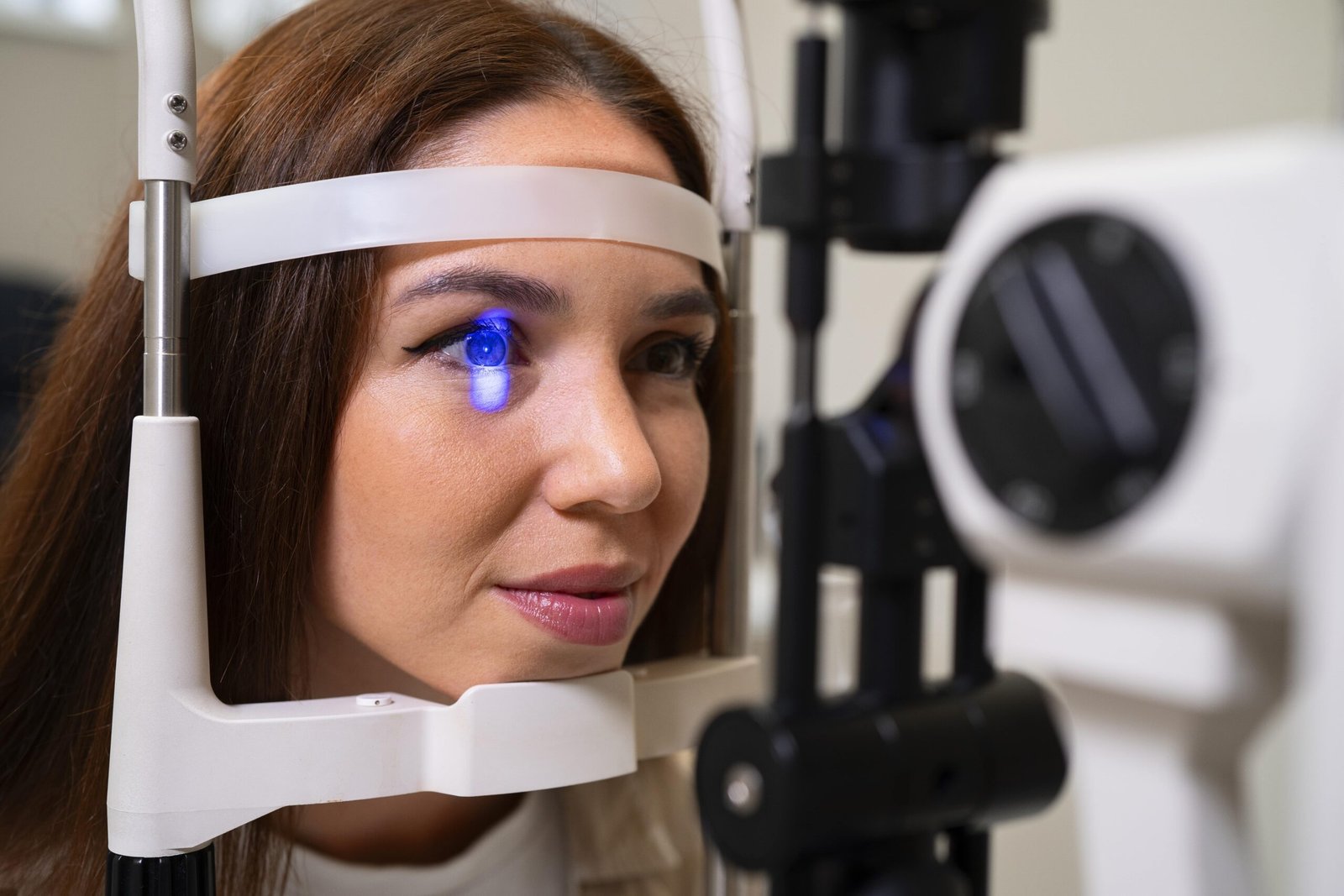
Cataract surgery removes the cloudy natural lens and replaces it with a clear intraocular lens, usually via micro-incision phacoemulsification under drop anaesthesia as a day procedure. Most patients notice clearer vision within days and resume routine activity quickly, with drops and reviews over the following weeks.
Before surgery
\n- \n
- Biometry — painless measurements of eye length and corneal curvature to calculate your implant power. \n
- Corneal assessment — astigmatism is measured (and may be addressed with a toric IOL or incision planning). \n
- Health review — blood pressure, sugar control and medication review; you will be told which medicines to continue. \n
- Counselling — IOL choice, expected recovery, and consent with an honest discussion of risks. \n
On the day
\n- \n
- Dilating and anaesthetic drops are applied; no injections are needed in most routine cases. \n
- A micro-incision of about 2–3 mm is made at the corneal edge. \n
- The cloudy lens is broken up with ultrasound (phacoemulsification) and removed. \n
- The folded IOL is inserted and unfolds inside the natural lens capsule. \n
- The self-sealing incision usually needs no stitches; a shield protects the eye. \n
Most patients go home the same day, typically within a few hours.
\nRecovery timeline
\n- \n
- Day 1: first review; vision already improving though often hazy. \n
- Week 1: steady clearing; light activity resumes; drops continue. \n
- Weeks 2–6: vision stabilises; final spectacle check when advised. \n
Do's and don'ts
\n- \n
- Use drops exactly as prescribed and keep follow-up appointments. \n
- Avoid rubbing the eye, splashing unwashed water, dust and heavy lifting in the early period. \n
- Report promptly: increasing pain, redness, sudden vision drop, flashes or many new floaters. \n
Results
\nThe great majority of patients see meaningfully better within days — brighter colours, sharper vision, less glare. Final results depend on the health of the rest of the eye (cornea, retina, optic nerve), which your surgeon assesses and explains beforehand. No specific outcome can be guaranteed.
Information on this page is for general education and does not replace an examination, diagnosis or personalised medical advice from a qualified eye-care professional.
FAQs: Cataract Surgery: Procedure, Recovery & Results
The procedure itself typically takes 10–20 minutes in straightforward cases; plan a few hours at the facility for preparation and observation.
Many desk-based patients return within a few days; physically demanding or dusty work may need a little longer. Your surgeon will advise based on your eye and occupation.
Related treatments & topics
Cataract Surgeon in Mumbai
A cataract is clouding of the eye's natural lens, causing blurred vision, glare and faded colours. Surgery — removing the cloudy l…
Learn morePhacoemulsification: Modern Micro-Incision Cataract Surgery
Phacoemulsification ("phaco") is the modern standard for cataract removal: the cloudy lens is broken into tiny fragments with ultr…
Learn moreIntraocular Lens (IOL) Options: Monofocal, Toric, Multifocal & Trifocal
The intraocular lens implanted during cataract surgery comes in several designs: monofocal (one sharp distance), toric (also corre…
Learn more